
A ceiling fan is one of those appliances you barely notice — until it starts making noise. Whether it's a persistent hum that interrupts your sleep, a rhythmic clicking that follows every rotation, or a rattling that kicks in only at high speed, a noisy ceiling fan can go from mildly annoying to genuinely disruptive in a hurry. The good news is that most ceiling fan noise problems are diagnosable and fixable without calling in a professional.
This guide walks you through the most common reasons your ceiling fan is making noise, how to identify which type of noise you're dealing with, and exactly what steps to take to quiet things down. We'll also cover when it makes more sense to replace the fan entirely — and how upgrading the lighting on or near your fan can make a real difference in your room's comfort and ambiance.
Why Ceiling Fans Get Noisy Over Time
Ceiling fans are mechanical devices, and like any machine that runs for hours at a time, they experience wear. Screws loosen, motor bearings dry out, blade brackets bend slightly, and internal components shift with the constant vibration of rotation. Even a brand-new fan can develop noise if it was installed incorrectly or if the electrical components in the circuit aren't compatible with its motor. Understanding why fans get noisy is the first step toward figuring out exactly which noise you're hearing and what's causing it.
In many cases, the fix is simple — a tightened screw here, a drop of oil there. But some noises signal deeper mechanical problems that won't go away with a quick tune-up. The key is learning to distinguish between them, which starts with paying close attention to the type of sound your fan is making.
Types of Ceiling Fan Noise and What They Mean
Not all ceiling fan noise is created equal. Different sounds point to different problems, and misdiagnosing the source can lead to wasted time and effort. Here's a breakdown of the most common noise types:
Humming or Buzzing
A low electrical hum is one of the most frequently reported ceiling fan complaints. This type of noise typically originates from the fan's motor or from an incompatible dimmer switch. Many ceiling fans are not designed to work with standard dimmer switches — even if the fan operates, the motor can produce a noticeable buzz when it receives irregular voltage. The hum may also come from the light kit if the bulbs are operating on an incompatible fixture or at a wattage the socket wasn't designed for.
Rattling or Shaking
Rattling is almost always a mechanical issue rather than an electrical one. The most common culprits are loose screws on the blade brackets, a loose canopy cover, or a light kit that isn't seated firmly against the fan body. Sometimes a light bulb that's slightly loose in its socket will rattle at certain speeds. The noise often changes with fan speed, getting louder at high settings and quieter (or disappearing) at low.
Clicking or Ticking
A rhythmic clicking that repeats with every rotation usually indicates that something is making intermittent contact as the blades spin. This could be a blade that's warped or bent slightly downward, a loose blade bracket that flexes with each pass, or a piece of debris (like a small screw or piece of wire insulation) caught somewhere in the housing. Clicking can also occur when pull chains swing freely and tap against the fan body or each other during operation.
Grinding or Scraping
Grinding is a more serious sound and one that shouldn't be ignored. It typically points to a problem inside the motor itself — either worn or dry bearings that need lubrication, or internal components that have shifted out of alignment. If your fan has been running for many years and suddenly develops a grinding noise, the bearings may simply be at the end of their service life. Continuing to run the fan in this condition can cause further damage and, in extreme cases, create a safety hazard.
Wobbling and Vibration Noise
A fan that wobbles doesn't just make noise — it also puts extra stress on the mounting hardware and the ceiling junction box. Wobble-related noise often sounds like a combination of rattling and a dull thudding and is usually caused by imbalanced blades, loose mounting hardware at the ceiling, or an undersized or improperly rated junction box that flexes under the fan's weight. This is one situation where addressing the problem promptly matters for safety, not just comfort.
The Most Common Causes of a Noisy Ceiling Fan
Once you've identified the type of noise, it becomes much easier to narrow down the root cause. Most noisy ceiling fans can be traced back to one of the following issues:
- Loose hardware: Blade screws, canopy screws, and light kit fasteners all loosen over time due to vibration. Even screws that feel snug to the touch can work themselves loose after months of operation.
- Unbalanced blades: Blades that differ even slightly in weight distribution will cause wobble and vibration noise. This can happen because of warping from humidity, accumulated dust, or minor damage during shipping or installation.
- Dry motor bearings: Most modern ceiling fan motors are sealed and self-lubricating, but older fans often have oil ports that require periodic maintenance. A dry bearing is a grinding fan waiting to happen.
- Incompatible dimmer switch: Standard dimmers are designed for resistive loads (like incandescent bulbs), not the inductive loads created by fan motors. Using the wrong dimmer is one of the most common — and most overlooked — causes of motor hum.
- Improper installation: A fan that wasn't mounted level, or whose blade brackets weren't installed at consistent angles, will vibrate and make noise from day one.
- Worn-out motor: Like all mechanical components, ceiling fan motors have a finite lifespan. Older fans that have run continuously for many years may simply be reaching the end of their operational life.
- Electrical interference: Certain LED bulbs with integrated drivers can create electrical noise that is amplified through the fan's light kit, particularly if the bulbs aren't dimmable or aren't rated for enclosed fixtures.
How to Fix a Noisy Ceiling Fan: Step-by-Step
Before starting any inspection or repair, always turn off power to the fan at the wall switch and, for added safety, at the circuit breaker. Once the fan has come to a full stop, work through the following steps in order:
- Tighten all visible screws — Use a screwdriver to check every accessible screw: the canopy screws at the ceiling, the blade bracket screws where each blade arm attaches to the motor, and the screws securing each blade to its bracket. Even a quarter-turn of tightening can eliminate rattling sounds.
- Check blade alignment and balance — Hold a ruler or level against each blade to check for warping or inconsistent angles. For small balance issues, blade balancing kits (available at hardware stores) attach a small clip or weight to the blade's top surface to correct the imbalance. For severely warped blades, replacement is the better option.
- Inspect the mounting bracket and junction box — Climb a stable ladder and gently try to wiggle the fan's mounting bracket. If there's any movement, the screws connecting it to the junction box need tightening. Also confirm that the junction box itself is rated for ceiling fan use — standard electrical boxes are not designed to handle the dynamic load of a spinning fan.
- Lubricate the motor (if applicable) — Check your fan's manual to see if it has an oil reservoir. If it does, top it off with the manufacturer-recommended non-detergent motor oil. Never use WD-40 or general-purpose sprays, as these can damage motor windings.
- Replace the dimmer switch — If your fan is on a dimmer, swap it for a standard on/off switch or a fan-rated speed controller. This alone resolves electrical humming in the majority of cases where the motor itself is in good condition.
- Secure or replace the light kit — If the noise is coming from the light kit area, make sure it's snugged up firmly to the fan body. Also check that bulbs are screwed in completely and that their wattage is within the fixture's rated limit.
- Check pull chains — Wrap a small piece of tape around pull chains that are contacting each other or the fan body, or tie them together loosely to prevent swinging during operation.
Working through these steps systematically will resolve the vast majority of noisy ceiling fan problems without any specialized tools or professional help.
When to Repair vs. Replace Your Ceiling Fan
Not every noisy fan is worth fixing. If your fan is more than 10 to 15 years old and the noise is coming from inside the motor, replacement is usually the smarter financial decision. Motor repairs on ceiling fans can cost nearly as much as a new unit, and a new fan will almost certainly be more energy-efficient and quieter out of the box. Similarly, if blade warping is severe enough that balancing weights don't help, and replacement blades aren't available for your model, that's another sign it's time to move on.
On the other hand, if your fan is relatively new, the motor sounds healthy, and the noise is clearly coming from loose hardware or an electrical mismatch, repairs are quick and inexpensive. A $5 set of replacement screws or a fan-rated wall control can restore a noisy fan to near-silent operation in under an hour.
Upgrade Your Ceiling Fan's Lighting While You're At It
While you're up there inspecting your fan, it's worth taking a look at the light kit as well. Many ceiling fan light kits ship with generic sockets designed for incandescent or CFL bulbs — and if you've swapped in LED bulbs without checking compatibility, those bulbs could be contributing to the hum you're hearing. Switching to quality LED bulbs rated for enclosed fixtures and appropriate for dimming (if your circuit uses a fan-rated dimmer) can make a noticeable difference in both noise levels and energy efficiency.
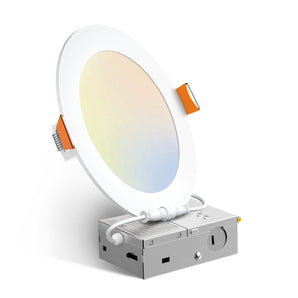
If your ceiling fan doesn't include a light kit, or if you're replacing the fan entirely and want to add more ambient or task lighting to the space, Amico's ceiling fan light options are worth exploring. For rooms where you want clean, recessed lighting to complement an existing fan, Amico's recessed lighting collection offers a range of ETL and FCC certified fixtures built for long-term performance at 50,000+ hours of LED lifespan. The 4-inch canless LED recessed lighting fixtures are particularly popular for bedrooms and living rooms, where a ceiling fan handles airflow and recessed lights handle ambient illumination — a combination that keeps the ceiling clean and uncluttered.
For larger spaces like kitchens, offices, or open-plan living areas, Amico's 6-inch recessed LED lighting delivers bright, even coverage with CRI 80+ color rendering that makes colors look natural and true. All Amico fixtures are designed for straightforward installation and ship free across the continental U.S., making it easy to upgrade the full lighting scheme of a room without a large upfront investment.
Tips to Keep Your Ceiling Fan Running Quietly
A little preventive maintenance goes a long way toward keeping your ceiling fan quiet for years to come. Most of these habits take only a few minutes and can prevent the slow development of noise problems before they start:
- Clean the blades regularly. Dust accumulation on fan blades adds uneven weight that can throw the blade balance off. Wipe blades down every few months with a damp cloth.
- Do an annual hardware check. Once a year, turn off the power and go over every fastener on the fan with a screwdriver. Catching loose screws early prevents rattling from developing.
- Use a fan-rated wall control. Always pair your ceiling fan with a speed controller or switch rated specifically for fan motors. This protects the motor from voltage irregularities and prevents electrical hum.
- Verify the junction box rating before installation. Any time you install or reinstall a ceiling fan, confirm that the junction box is rated for ceiling fan use (typically 35 lbs or more). A box that flexes under load will always create vibration noise.
- Choose compatible light bulbs. Use LED bulbs specifically rated for enclosed fixtures and within the wattage limits listed on the fan's label. Oversized or incompatible bulbs can cause both noise and overheating.
- Install on a level surface. If the ceiling is sloped, use a fan-rated angled mounting kit. A fan that hangs at the wrong angle will wobble and vibrate from the first moment it's turned on.
A Quieter Fan Is Usually One Tune-Up Away
Most noisy ceiling fans aren't broken — they're just overdue for a little attention. Whether it's a loose screw causing a rattle, an incompatible dimmer switch creating a hum, or unbalanced blades producing a wobble, the majority of ceiling fan noise problems are surprisingly easy to fix once you know what you're looking for. By working through the troubleshooting steps in this guide, you can restore a noisy fan to quiet, smooth operation without spending much time or money.
And if you find yourself rethinking the room's lighting setup while you're at it, that's not a bad instinct. Clean, efficient LED lighting paired with a well-maintained ceiling fan is one of the most comfortable and energy-smart combinations you can put in a bedroom, living room, or any high-traffic space in your home.
Outfitting Multiple Rooms or a Whole Property?
If you're a contractor, property manager, or business owner looking to upgrade lighting across multiple spaces, Amico's bulk sales program offers tiered volume discounts with no complicated ordering process. From recessed lighting and flat panel lights to high bay lights and industrial lighting, Amico has ETL and FCC certified fixtures for every application — all backed by free shipping and a 30-day return policy.