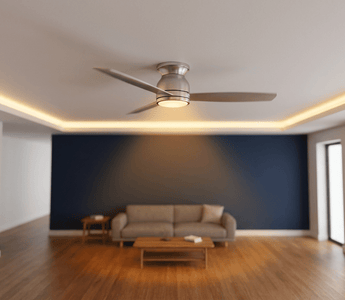
If you've ever stood in a room with an 8-foot ceiling and wondered whether you can safely install a ceiling fan, you're not alone. Millions of homes — especially older builds and apartments — have ceilings that sit right at or below the 8-foot mark, leaving very little room for traditional fan installations. The good news is that the ceiling fan industry has engineered a purpose-built solution: flush-mount ceiling fans, sometimes called hugger fans, that sit directly against the ceiling and keep their total drop under 12 inches. These fans make it possible to enjoy the comfort and energy savings of a ceiling fan without sacrificing headroom or safety.
But not all flush-mount fans are created equal. Some are underpowered, some are poorly lit, and some look like afterthoughts bolted to the ceiling. In this guide, we'll walk you through every dimension of choosing the best ceiling fan for a low ceiling — from the critical safety measurements and CFM performance numbers you need to know, to how integrated LED lighting can transform a cramped room into a bright, comfortable space. Whether you're outfitting a bedroom, living room, or covered porch, you'll find the right information to make a confident, well-informed purchase.
Why Low Ceilings Demand a Flush-Mount Fan
A standard ceiling fan with a downrod can add 12 to 18 inches — or more — to the distance between the ceiling and the blade tips. In a room with a 9- or 10-foot ceiling, that's not a problem. In a room with an 8-foot ceiling, it's a serious safety issue. Building codes and safety standards universally require ceiling fan blades to remain at least 7 feet above the floor. That leaves just 12 inches of total clearance on an 8-foot ceiling for the entire fan assembly. A flush-mount or hugger fan is specifically engineered to fit within that window, mounting its motor housing directly to the ceiling bracket without any downrod in between.
Beyond safety, there's also a practical airflow concern. When a fan hangs too low in a small room, the airflow can feel turbulent and concentrated rather than evenly distributed. Flush-mount fans, by positioning the blades closer to the ceiling, push air down in a broader, more diffuse pattern — which actually works well in low-ceiling environments where you want gentle, room-wide circulation rather than a direct blast. The key is finding a model that pairs a compact profile with a motor powerful enough to compensate for the reduced blade clearance from the ceiling surface.
Safety Measurements: The Math You Must Do First
Before you browse a single product page, grab a tape measure and do the math. This step takes five minutes and will immediately eliminate a large portion of fans from your list. Start by measuring your ceiling height from the finished floor. If you have a standard 8-foot ceiling, that's 96 inches. Subtract the mandatory 7-foot (84-inch) blade clearance, and you're left with exactly 12 inches of space for the fan from the ceiling to the lowest point of the blades. That's your hard budget for the fan's total drop.
Here's how to use that number when shopping. Look for the fan's listed "ceiling to blade" measurement or "total height" in the product specifications. Any fan with a total installed height at or under 12 inches is a candidate. Many quality flush-mount models come in at 8 to 11 inches, giving you a small buffer. It's also worth checking whether the fan requires a specific mounting box — flush-mount fans must be installed on a fan-rated electrical box, not a standard light fixture box, because they need to support both weight and constant vibration loads.
| Ceiling Height | Available Fan Drop (after 7 ft. clearance) | Recommended Mount Type |
|---|---|---|
| 7 ft. (84 in.) | 0 in. — Not recommended | Ceiling fan not advised |
| 7.5 ft. (90 in.) | 6 in. — Very limited | Ultra-low-profile flush mount only |
| 8 ft. (96 in.) | 12 in. — Flush-mount required | Flush-mount / hugger fan (under 12 in.) |
| 8.5–9 ft. | 18–24 in. — Short downrod possible | Flush-mount or short downrod |
What "Under 12 Inches" Really Means for Your Ceiling
When a fan is advertised as "flush-mount" or "low-profile," that label alone doesn't tell you everything. The number you actually need is the fan's total installed height — measured from the ceiling surface down to the lowest point of the fan, whether that's the blade, the light kit, or the motor housing itself. Some manufacturers list this clearly; others require a bit of digging through the spec sheet. Look for terms like "ceiling-to-blade distance," "total height," or "installed height." If a product page doesn't list this clearly, contact the manufacturer before purchasing.
It's also worth understanding that "under 12 inches" is a ceiling height constraint, not a performance constraint. Many flush-mount fans with a 10- or 11-inch profile deliver airflow ratings that rival standard downrod fans. The engineering challenge is real, but the best manufacturers have solved it with high-torque motors, optimized blade pitch angles (typically 12 to 15 degrees), and aerodynamic blade profiles that maximize air movement per rotation. Don't assume that a lower profile means weaker performance — when you shop smart, you won't have to make that trade-off.
CFM and Airflow: Choosing a Fan That Actually Works
CFM (Cubic Feet per Minute) is the single most important performance number on a ceiling fan's spec sheet. It tells you how much air the fan moves per minute at its highest speed setting. A higher CFM means more effective cooling and air circulation. When comparing fans, always look at CFM alongside the fan's wattage to calculate CFM per watt — this is your efficiency metric, telling you how much air movement you get per unit of energy consumed. The Department of Energy considers a ceiling fan efficient when it delivers a high CFM-per-watt ratio, and energy-conscious buyers should prioritize this number.
For flush-mount fans specifically, a good CFM rating is achievable even at a compact size. Here's a simple framework for matching CFM to your room:
- Small rooms up to 100 sq. ft. (bathrooms, home offices, laundry rooms): Target 1,000–3,000 CFM
- Medium rooms 100–225 sq. ft. (bedrooms, dining rooms, smaller living areas): Target 3,000–4,500 CFM
- Large rooms 225–400 sq. ft. (master bedrooms, open living rooms, sunrooms): Target 4,500–6,500+ CFM
One important note: a fan's published CFM is typically measured at maximum speed with no light kit attached. If you add an integrated light kit, airflow may be marginally reduced. Manufacturers of quality flush-mount fans account for this in their design, but it's worth keeping in mind when comparing spec sheets. Also look for fans with multiple speed settings and, ideally, a DC motor — DC-motor fans are significantly quieter and more energy-efficient than their AC counterparts, which matters a lot in bedroom applications.
Matching Blade Span to Room Size
Ceiling height is only one dimension of the sizing puzzle. The fan's blade span (also called blade sweep or diameter) needs to match the floor area of the room to ensure proper air circulation. A fan that's too small for the room will spin constantly without making a dent in stuffiness. One that's too large can create an uncomfortable downdraft and may look visually overwhelming in a compact space. The good news is that the guidance here is straightforward.
- Up to 144 sq. ft.: Choose a fan with a 36–44 inch blade span
- 144–225 sq. ft.: Look for a 44–52 inch blade span
- 225–400 sq. ft.: A 52–60 inch blade span is appropriate
- Over 400 sq. ft.: Consider two fans or a single fan 60 inches or larger
Beyond the blade span itself, always leave at least 18 inches of clearance between the blade tips and the nearest wall or large piece of furniture. Blades spinning too close to a wall create turbulence that reduces effective airflow and increases noise. If your room is on the narrower side, factor this in when selecting blade span — a slightly smaller fan that fits with proper wall clearance will outperform a larger fan crammed into a tight space.
Ceiling Fan Lighting: Making the Most of Your Overhead Space
In a room with a low ceiling, every fixture competes for vertical real estate. That's one of the strongest arguments for choosing a ceiling fan with an integrated light kit — you get two functions from a single ceiling cutout, which is especially valuable when adding a separate pendant or flush-mount fixture would eat up even more headroom or clutter the ceiling. When evaluating ceiling fan lighting, look beyond the wattage and consider the light kit's overall profile, the color temperature options available, and whether the output is dimmable.
Integrated LED light kits are the gold standard in modern ceiling fans. They add virtually no additional height to the fan's profile (often just 1–2 inches compared to a glass bowl or globe fixture), consume a fraction of the energy of incandescent alternatives, and last far longer. Look for light kits that offer adjustable color temperature — the ability to switch between a warm 2700K glow for evening relaxation and a brighter 4000K daylight tone for task-oriented activities makes the fan genuinely versatile across different usage scenarios. Dimmability is equally important; a fan light you can't dim will always feel either too harsh or inadequate. Explore Amico's full range of ceiling fan lights to find compatible LED options that integrate cleanly with your fan setup.
Complementary LED Lighting for Low-Ceiling Rooms
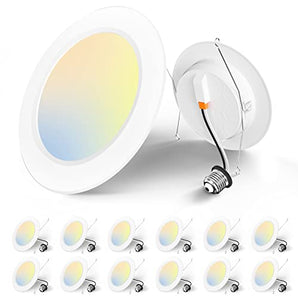
Even with a well-lit ceiling fan, low-ceiling rooms often benefit from layered lighting that avoids adding bulk to the ceiling plane. This is where recessed lighting becomes particularly valuable. Recessed lighting sits completely flush with the ceiling surface, adds zero drop, and can dramatically improve the brightness and atmosphere of a room without competing with your fan for vertical space. Paired strategically around the perimeter of a room, recessed lights complement the fan's central position and eliminate the shadowy corners that a single overhead fixture often leaves behind.
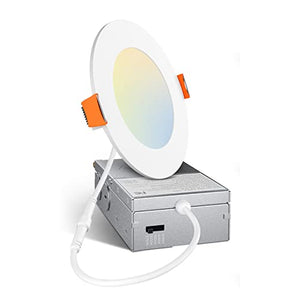
For most living rooms and bedrooms, 6-inch recessed LED fixtures strike the right balance between light spread and fixture visibility. For tighter spaces like hallways, bathrooms, or accent lighting zones, 4-inch canless LED recessed lights are an excellent choice — they're slim, easy to install without a housing can, and deliver clean, focused output. Amico's canless recessed fixtures feature ETL and FCC certification, a CRI of 80+, and a rated lifespan of 50,000+ hours, meaning you won't be replacing bulbs anytime soon. The LED module and trim are built as a single integrated unit, so installation is straightforward — no separate components to assemble before fitting into the ceiling.
If you're working in a space that also needs task lighting or directional accent light, gimbal recessed lights offer an adjustable beam angle that lets you direct light exactly where it's needed — ideal for highlighting artwork, reading nooks, or kitchen counters in rooms where ceiling height limits your fixture options. And if you're looking for simple ambient or decorative lighting on a budget, LED flat panel lights are another surface-mount option that adds virtually no depth while delivering broad, even illumination across the room.
Style and Finish: Picking a Fan That Fits the Room
Once you've narrowed your list based on measurements, CFM, and lighting specs, style becomes the deciding factor. The good news is that the flush-mount fan market has matured significantly, and you're no longer limited to bland, boxy designs. Today's low-profile fans are available in a wide range of finishes and blade configurations that suit everything from minimalist modern interiors to cozy farmhouse aesthetics.
Modern and Minimalist Spaces
For contemporary rooms with clean lines and neutral palettes, look for fans with 3-blade configurations in matte black, brushed nickel, or satin silver finishes. The fewer blades and sleeker motor housing create a more architectural look that reads as intentional rather than utilitarian. Pair the fan with flush-mounted recessed lighting in a cool 4000K color temperature to reinforce the crisp, modern feel of the space.
Traditional and Transitional Interiors
In rooms with warm wood tones, classic furniture, or a more traditional sensibility, five-blade fans in brushed bronze, oil-rubbed finish, or warm wood grain work beautifully. These fans often pair well with a light kit in a warm 2700K–3000K color temperature to reinforce the cozy, inviting atmosphere. The key is to match the fan's finish to at least one other metal element in the room — door hardware, light fixtures, or furniture accents — so it feels cohesive rather than random.
Covered Porches and Sunrooms
Outdoor-rated flush-mount fans are available in damp-rated and wet-rated configurations. For covered porches or screened sunrooms, a damp-rated fan is sufficient. Look for weather-resistant finishes and blade materials (often ABS plastic or treated wood composites) that won't warp or corrode in humid conditions. These spaces benefit from fans with a slightly higher CFM since air circulation on a porch is less contained than in a fully enclosed room.
Installation Tips for Flush-Mount Ceiling Fans
Installing a flush-mount ceiling fan is a manageable DIY project for most homeowners, but there are a few non-negotiable steps that determine whether the fan runs safely and quietly for years. The first is verifying that your existing electrical box is fan-rated. Standard light fixture boxes are not designed to handle the dynamic load of a spinning fan — they can work loose over time and create a genuine fall hazard. A fan-rated box is listed for a specific weight capacity and is designed to absorb vibration. If yours isn't fan-rated, replacing it before installation is a necessary first step, not an optional one.
When making the wiring connections, always use push-in wire connectors. Insert the stripped wire ends into the appropriate connector ports until they click securely into place — no twisting required. This method creates a more reliable connection than traditional alternatives and is considerably easier to work with inside a tight ceiling junction box, which is exactly the scenario you'll encounter with a flush-mount installation. Once the fan is mounted and wired, use the blade balancing kit (included with most quality fans) to eliminate any wobble before running the fan at full speed. A balanced fan is a quiet fan, and quiet matters especially in bedrooms where the fan runs overnight.
Frequently Asked Questions
Can I use a very short downrod instead of a flush-mount fan on an 8-foot ceiling?
In most cases, no. Even the shortest available downrod (typically 3 to 6 inches) adds to the motor housing height, which on most standard fans is already 8 to 12 inches tall. The combined total will likely put your blade clearance below the required 7-foot minimum on an 8-foot ceiling. Flush-mount fans solve this by eliminating the downrod entirely and using a compressed motor housing specifically designed to stay within the 12-inch total drop budget.
Do flush-mount fans move as much air as standard downrod fans?
High-quality flush-mount fans can absolutely match or approach the airflow performance of comparable downrod models. The critical factor is the CFM rating paired with a well-designed motor. Some budget flush-mount fans do underperform, which is why CFM per watt is such an important metric to evaluate rather than just looking at the fan's profile. A well-engineered hugger fan with a strong motor and properly pitched blades delivers serious airflow — the engineering challenge has been solved by quality manufacturers.
What's the difference between damp-rated and wet-rated fans for outdoor use?
Damp-rated fans are designed to withstand moisture in the air — humidity, condensation, and indirect exposure to rain — making them suitable for covered porches, screened enclosures, and bathrooms. Wet-rated fans are engineered to handle direct water exposure, such as open patios or pergolas without a roof, and use fully sealed components throughout. For most covered outdoor applications, a damp-rated flush-mount fan is sufficient and offers a wider range of style options.
How do I improve overall light levels in a low-ceiling room beyond the fan's light kit?
Layering your lighting is the most effective approach. Combine your ceiling fan's integrated LED light kit with recessed lighting installed flush to the ceiling. Canless LED recessed lights are particularly well-suited to low-ceiling rooms because they require no housing can and sit completely flush with the drywall. Adding three to six recessed lights around the perimeter of the room, wired as parallel connections from the same circuit, creates even, layered illumination without adding any depth to the ceiling or competing with the fan's airspace.
The Bottom Line on Flush-Mount Ceiling Fans for Low Ceilings
Low ceilings don't have to mean compromised comfort or limited options. With the right flush-mount ceiling fan — one that stays under 12 inches total, delivers a CFM rating matched to your room size, and pairs with quality integrated LED lighting — you get everything a standard fan offers without the headroom penalty. The key is doing the measurement math first, then evaluating performance specs, and only then narrowing down by style and finish. Skip any one of those steps and you risk ending up with a fan that either isn't safe, isn't effective, or simply doesn't fit the space visually.
And remember: the ceiling fan is just one piece of your room's lighting and comfort puzzle. Pairing a well-chosen flush-mount fan with strategically placed recessed LED fixtures from Amico creates a layered, energy-efficient lighting scheme that makes even a low-ceiling room feel bright, open, and thoughtfully designed. With ETL and FCC certified fixtures, a 50,000+ hour LED lifespan, and free sitewide shipping, Amico makes it easy to complete the whole picture — not just one fixture at a time.
Outfitting Multiple Rooms or a Commercial Property?
Amico's bulk sales program offers tiered volume discounts for contractors, property managers, and businesses. Whether you need recessed lighting, flat panel lights, or ceiling fan light kits across multiple units, our wholesale team will build a custom quote that fits your project and your budget.
Request a Wholesale Quote